
Saturday, April 05, 2008
My Wife
If you know my wife, then you know that this picture describes her pretty well. Starbucks and reading (esp. Piper books) sum her up pretty well :-) I love you Baby!


Monday, March 31, 2008
Book Review: Isaiah's New Exodus in Mark

I recently finished reading Isaiah's New Exodus in Mark by Rikki Watts, now a professor at Regent College in Vancouver, BC. Anyone who has the technical ability to wade through the Greek and Hebrew references will glean pure gold from this work! It has opened my eyes to understanding the Gospels as well as the ministry of Jesus in a Biblical-Theological framework. I'm including my review which I wrote for my Exegesis of Mark class. Hopefully this can whet your appetite for more to come!
Given the rise of literary criticism as a sub-discipline of Biblical Studies and the resurgence of interest in theological interpretation, there has been a greatly renewed interest in the Gospels in their final, canonical form. With regards to the Gospel of Mark, this new scholarly climate has resulted in greater attention and debate as to Mark’s overall literary organization and the bearing that it has for Mark’s Biblical Theology. It is into this milieu that Rikki Watts has presented Isaiah’s New Exodus in Mark. His central thrust is that Mark has structured his gospel account in order to demonstrate that Jesus, in His life, ministry, death and resurrection, fulfilled the long standing Jewish hope of a New Exodus and consequent end to exile that had been promised in the Prophet Isaiah. Thus, Jesus both stands in continuity with and yet redefines the hopes that Israel had been carrying with her for centuries.
Argument of the Book:
Watts begins his studying with an examination of the major literary-theological works on the Gospel of Mark in the past 50 years. He is careful in each instance to note the important contributions and insights that each author has into Mark but also demonstrates that each author comes up short when trying to see a unified way in which Mark structures his gospel and draws on Old Testament imagery. One constant motif that emerges again and again in the surveyed literature is the theme of Exodus and the noted use of Exodus imagery in the Gospel. Watts notes that these authors are successful in demonstrating a link to the Exodus at individual points in the Gospel but are less compelling when they attempt to see an overarching Exodus structure. Although he hints as his solution to this difficulty, namely that Mark makes use of the Exodus motif in as much as it was reinterpreted in Isaiah 40-66, he saves this assertion for a later point in his work.
Watts begins his studying with an examination of the major literary-theological works on the Gospel of Mark in the past 50 years. He is careful in each instance to note the important contributions and insights that each author has into Mark but also demonstrates that each author comes up short when trying to see a unified way in which Mark structures his gospel and draws on Old Testament imagery. One constant motif that emerges again and again in the surveyed literature is the theme of Exodus and the noted use of Exodus imagery in the Gospel. Watts notes that these authors are successful in demonstrating a link to the Exodus at individual points in the Gospel but are less compelling when they attempt to see an overarching Exodus structure. Although he hints as his solution to this difficulty, namely that Mark makes use of the Exodus motif in as much as it was reinterpreted in Isaiah 40-66, he saves this assertion for a later point in his work.
From his survey of previous works on Mark, he proceeds to articulate a hermeneutic that he argues Mark has made use of in bringing the OT to bear on his narrative. Through a detailed analysis of Ideology as expressed in the discipline of Sociology, he explains that a community will maintain its identity and self-understanding based on continuous reference to what he calls its unique founding moment. Based on this unique founding moment, an author may make textual allusions that are designed to make the reader recall a whole historical, sociological grid. He writes, “I suggest that his (Mark’s) ‘grand piano’ is a schematized interpretive ‘map’ of Israel’s ‘history’ and that his OT part-citations or allusions may function as ‘grid references’ to that map which gives expression and order to Israel’s interpretation of her history, namely the OT.” In light of this understanding and the often observed influence of Isaiah 40-55 on Mark, Watts proceeds to examine the gospel to see how Mark’s use of OT citations, allusions and imagery may shed light on the structure of Mark’s gospel.
Particularly key for Watts’ argument is the function of the opening conflated citation of Isaiah 40:3 and Malachi 3:1 in Mk 1:2-3. Isaiah 40 introduces his New Exodus (NE) schema that is developed throughout the remained of the book. He argues that the Malachi 3 portion of the citation functions as a development of Isaiah’s NE expectation that serves to explain why his NE has been delayed. Together, they form a controlling ‘grid reference’ by which the reader is alerted to the interpretive framework that Mark is attempting to develop and argue for through his narrative. Watts writes,
“for Mark the long-awaited coming of Yahweh as King and Warrior has begun, and with it, the inauguration of Israel’s eschatological comfort: her deliverance from the hands of the nations, the journey of her exiles to their home and their eventual arrival at Jerusalem, the place of Yahweh’s presence.”This editorial citation functions according to the norm of ancient literature in which such a citation establishes the conceptual framework for the remainder of the work.
The bulk of the rest of Watt’s book serves to demonstrate how looking at Mark from the perspective of the fulfillment of an INE schema serves to make better sense of Mark’s structure than previous proposals and ultimately demonstrates that, at least for Mark, Jesus’ ministry was the culmination of the long-awaited hopes of YHWH’s deliverance of Israel although in Jesus both Israel and their hope are drastically redefined. Watts, along with many other commentators, sees two major breaks in the Gospel’s narrative at 8:21-27 and 10:45-11:1 which would divide the book into a three part structure consisting of Jesus’ ministry in which He preaches and performs miracles, Jesus leading His blind and deaf disciples along a ‘way’ and finally an arrival in Jerusalem. According to Watts, this structure
“displays broad parallels with the INE schema of A) Yahweh’s deliverance and healing of his exiled people, B) a journey where ‘blind’ Israel is led along ‘a way they do not know’, and C) arrival in Jerusalem.”At each point in each of these three major sections, he is careful to demonstrate how the major features of the narrative demonstrate are consistent with a NE hermeneutic and how such a hermeneutic lends a hand in helping solve difficult interpretive questions in the work.
Finally, Watts concludes his study with a chapter in which he recognizes the limitations or temptations of such a study to make all the evidence fit within the desire schema. So, in good critical realist fashion, he sets forth the Theory of Consilience and the criterion of simplicity from the Philosophy of Science in an effort to justify his study. So, while he admits that he may not be completely convincing at every stage of his argument for a controlling NE framework for Mark’s gospel, it “leads to a greater degree of consilience than any other literary theory yet proposed for Mark in that it explains and integrates a large number of previously separate classes of recognized phenomena.”
Evaluation:
Isaiah’s New Exodus in Mark is, I believe, a masterful and well argued study of Mark’s Gospel which seems to shed light on its narrative technique as well as the Biblical Theology that it sets forth. Watts displays a great degree of skill in both Greek and Hebrew exegesis and appears to be knowledgeable about nearly every major secondary source on the Gospel of Mark extant at the time of his writing (his bibliography is nearly 45 pages long!). He brings these skills together to weave a convincing picture of what Mark is up to in his gospel.
Isaiah’s New Exodus in Mark is, I believe, a masterful and well argued study of Mark’s Gospel which seems to shed light on its narrative technique as well as the Biblical Theology that it sets forth. Watts displays a great degree of skill in both Greek and Hebrew exegesis and appears to be knowledgeable about nearly every major secondary source on the Gospel of Mark extant at the time of his writing (his bibliography is nearly 45 pages long!). He brings these skills together to weave a convincing picture of what Mark is up to in his gospel.
It could be argued that at times Watts does cook his evidence to fit into a NE schema. Indeed, when at an exegetical or theological impasse, a reference to Mark’s controlling INE framework seems to be, at least for him, what would tip the scales of interpretation in favor of his hermeneutic. So, in these instances, his arguments can become admittedly circular, a fact which he appears to recognize as he writes his final conclusion to the work. However, it should be noted again that this study does not rise or fall on individual interpretations of events and pericopae. The strength of his argument is that it seems to better fit the evidence than any other scheme that that has yet been proposed. He recognizes that there are other OT themes and motifs at work in the gospel other than a NE one and so he shows appropriate scholarly humility in holding individual interpretations loosely. What is important for him is that the INE motif provides the “conceptual framework” for the narrative.
One area in which I wish Watts could have been clearer was in his assertion that Jesus’ ministry was, at least for Mark, the fulfillment of the NE hope of Isaiah. However, it never seems to be defined clearly what he means by “fulfillment”. One wonders whether he understands to be Mark attempting to show a partial fulfillment, an inaugurated fulfillment or a final fulfillment of Isaiah’s prophecy. It seems that there are clues in the gospel that would lead one to see the events of Jesus’ ministry in Mark as an initial or “inaugurated” fulfillment and more careful nuancing on Watts’ part would have lead, I think, to an even larger theological payoff for the work in terms of helping to articulate a broader New Testament Theology.
Conclusion:
Isaiah’s New Exodus in Mark appears to be a groundbreaking study on Mark’s gospel which sheds much light on what is happening in the work from both a literary and a theological perspective. As I’m sure it already has been, I believe that it will continue to be a resource and base from which many scholars can penetrate further into the gospel in an attempt to mine the riches that are there for the Church. I pray that in this way, it will cause people to more fully appreciate the work that Christ did on Earth in His life, death and resurrection and bring the Church to stand in greater awe and worship of YHWH through His Servant, Jesus.
Tuesday, March 04, 2008
Why the Prosperity Gospel is not Gospel!
Here's a powerful video showing John Piper explain why the "Prosperity Gospel" is not true gospel at all.
ht: Justin Taylor
ht: Justin Taylor
Thursday, December 20, 2007
Christmas Break!!!
I am now officially on Christmas Break and it feels amazing! I don't think that I've ever longed for a Christmas break as much as I have this semester. My first semester at Wheaton has been so sweet and yet so challenging all at once. The Bible feels more real to me and God more majestic and awesome than I've felt for quite a while and for these things I'm so grateful to Him! But, this picture sums up pretty well how I feel right now:

So, on to Christmas Break! Katie and I leave early tomorrow morning for a week in California where we're absolutely excited to see our families, our church family at Copperhill and enjoy not worrying about snow! We're praying that it would be a sweet time of fellowship and that God would make us sad, again, to leave.
I'm hoping to do some intense reading over the break in order to get ready for next semester. My first project is to finish Jesus and the Victory of God by N.T. Wright. I'm actually considering starting it over since I think I would be all the more benefitted by it after this semester. Wright has some important things to say to the church and he seems to have become the force to be reckoned with in Biblical Scholarship.
Following that, if there even is a follow up to that, I would also like to finish The Temple and the Church's Mission by G.K. Beale, one of my professors at Wheaton. This book traces the Temple theme throughout scripture and then relates it to the purpose of the church at this stage of redemptive history. I think that this book has a lot of practical value in helping Christians to think theologically about the presence of God.
If I happen to have a few minutes to spare, I would also like to reacquaint myself with some of Milton's poetry. Milton is so refreshingly God-centered and his Biblical emphasis on discernment is something that is desperately needed in our contemporary theological and church climate. I love and advocate a "Missional" approach to ministry but so many people and ministries that claim the label "missional" are really just a sell out to our culture. We need to think about and engage our culture in a gloriously God-centered and countercultural way so that God is seen for who He is. I think Milton has a lot to say to us in this particular regard!
Maybe after all that I'll enjoy some fiction. I want to try and make sure that my mind doesn't become accustomed to reading only dense treatises. Fiction is good for the mind and helps us read the Bible in a more true-to-life manner. If anyone has some good suggestions for fiction, feel free to let me know!
Well, I pray that God blesses you all this Christmas Season with the knowledge and comfort that come from the amazing truth of the incarnation. I leave you with a quote from Daniel Fuller regarding the astonishing fact of God becoming man:
"Some idea of how much glory Jesus therefore lost in his incarnation can be found in the words of a well-known hymn that speaks of his leaving the "ivory palaces" and coming into a "world of woe." A helpful picture to have in mind is that of Jesus' descending a winding staircase stretching for a very long distance from the glory of heaven above far down into a world of wretched misery. Each downward stop in leaving this glory increased the pain Jesus underwent to pay for our sins, and so a good part of the severity of the punishment Jesus suffered for us consisted in coming down this staircase, whose length cannot be exaggerated, since it spanned the infinite distance between the Creator and the creature."
-Daniel Fuller in Unity of the Bible
Wednesday, December 05, 2007
Tuesday, August 21, 2007
Why Is Missional Important? Pt. 1
There are many facets of the answer to the question I posed above but let me show you my cards beforehand and say: Missional theology and ministry is important because it gets the Gospel! If this is the case then the trendy label “missional” is at least an accurate description of a key aspect of our Biblical faith and at most an apt synonym for the entire package of Biblical Christianity.
Now, after making such a bold statement the question could legitimately be asked, “If Missional is a buzzword for Biblical Christianity then why the label?” Let me give some background: The modern missions movement begain in the late 1700’s when the renown Reformed Baptist and Father of Modern Missions, William Carey, departed England for India. As he went out and other western missionaries followed his example into the uttermost parts of the Earth they were all forced to come to grips with an aspect of the task they were entrusted with. That is, they were forced to deal with the phenomenon of Culture and in case anyone is wondering, 18th century European and North American culture was in no way similar to the various cultures that met these pioneering missionaries as they spread out over the non-western world. And so, while the essential gospel message that these men and women taught was the same it took different shapes and forms in order to incarnate itself into the local culture. They had discovered essentially what Paul meant when he said:
For though I am free from all, I have made myself a servant to all, that I might win more of them. To the Jews I became as a Jew, in order to win Jews. To those under the law I became as one under the law (though not being myself under the law, that I might win those under the law. To those outside the law I became as one outside the law (not being outside the law of God but under the law of Christ) that I might win those outside the law. To the weak I became weak, that I might win the weak. I have become all things to all people, that by all means I might save some. I do it all for the sake of the gospel, that I may share with them in its blessings
- 1 Corinthians 9:19-23 ESV
As time progressed, Missionaries became more and more skilled at incarnating the gospel into the various cultures to which they were sent and principles began to be developed on how to handle the difficult balance of being faithful to the message and theology of the Gospel and how to dress that message in the clothing of the local people. However, even while these developments were happening in missions, there was an neglect of these principles at home in the Western world. For a long time though, churches were able to continue to preaching and teaching in the ways that they always had while being oblivious to the culture because at its core, Western Society was still firmly rooted in an understanding of the gospel. Christians were oblivious to how to incarnate the gospel because, to a great extent, they didn’t need to.
However, with the increase in Philosophical Skepticism and the increasing advance of Cultural Postmodernism, we in the West are now living in a Post-Christian society and culture. The air we breathe is not the same air that even our Parents or Grandparents grew up breathing and this calls for new ways for the gospel to be articulated in order for it to be brought to bear on our culture. Basically, the Western church is now in desperate need of the incarnational principles that have been developed by missionaries and missions agencies serving in non-western contexts. However, now these ideas and principles are being applied at HOME. There is an enormous need for the church to be missionaries in OUR OWN CULTURE. This is where we get the term “missional”.
One thing I would like to point out is that the Church’s role as “missionaries” in it’s own culture is technically not a new development. This is what the Church has ALWAYS been called to and it is only because it has largely NEGLECTED this mission that we now find ourselves in a position where some who claim the name of Christ are actually hostile to this idea of incarnating the gospel into our own 21st century Western Context. It is only because the fish worked hard enough to convince itself that it wasn’t living in water that it was surprised to wake up one morning feeling wet. But more on that tomorrow…
Filled by God
To be filled with You, O God, what would be the cost?
Would it be the mocking and jesting of the multitude,
Or even the sacrifice of my flesh on the altar?
To be stripped, beaten; bruised, battered;
Ripped and torn, speared and skewered,
These are what my precious Lord demands of me?
Then let them be mine, with all the joy that there attends;
For I am not filled with I, but with Thee!
Joy in Thanksgiving

This is from an article that I wrote for the Carey Baptist Church newsletter while I was in India. I know that our Thanksgiving/Holiday season is still a few months away but I hope that it can be profitable in preparing us mentally and spiritually for these occasions.
The Christian’s Delight in Thanksgiving
By
Scott Newman
“Offer to God a sacrifice of thanksgiving, and perform your vows to the Most High… The one who offers thanksgiving as his sacrifice glorifies me; to one who orders his way rightly I will show the salvation of God!”
-Psalm 50:14+23
In my home town, as the summer months give way to the cooler air and brighter colours of autumn a festive sprit begins to be felt among all the people. Then, as the calendar rolls on into the month of November, one can notice that all the markets and places of business begin to be decorated with the gorgeous hues of fallen leaves and cornucopias filled with delicious food. The holiday of Thanksgiving is then celebrated on the fourth Thursday of November. Thanksgiving is not just an American holiday, many people from all over the world celebrate Thanksgiving during the month of November when, traditionally, the farmers would finish gathering all their crops and villages would gather to celebrate the bountiful harvest and to praise God for His abundant provision for them. This time of year has, for many cultures, become a time to reflect on the blessings that have been bestowed on them during the past year.
In reflecting on the idea of Thanksgiving as a cultural event in many parts of the world, I began to wonder what the idea of Thanksgiving should mean for the Christian. There are many people all over the world who have not repented of their sins and live in peaceful fellowship with Christ who set aside time to be thankful for what they have. In my home town, often the Thanksgiving celebrations of the Christians differ very little from those who have no commitment to Christ whatsoever. This began to puzzle me as I thought about it. It seems that the motivations and the ways that at Christian gives thanks should be much different than the ways a non-Christian would give thanks. But how should this be? As I reflected on this apparent dilemma, I remembered Psalm 50; one of my favorite Psalms. I believe that a little reflection on what the Psalmist, Asaph, has to tell us here will change the way that many of us view and practice thanksgiving.
Asaph begins this psalm with a marvelous statement of the greatness and glory of our God. He speaks of God’s power in ruling creation, the light and perfection of His beauty, and His holy hatred towards sin. Then, God Himself begins to speak and condemns the Israelites for their sacrifices which they were offering to Him saying, “I will not accept a bull from your house or goats from your folds. For every beast of the forest is mine, the cattle on a thousand hills. I know all the birds of the hills, and all that moves in the field is mine. ‘If I were hungry, I would not tell you, for the world and its fullness are mine.’” God is rebuking the Israelites for thinking that they were somehow helping Him out with their sacrifices. As the creator and sustainer of the Universe, everything belongs to God and so, when the Israelites would come and offer sacrifices, they were offering to God things that already belonged to Him. So then, if God already owned these things, then why would He command the Israelites to bring sacrifices to Himself? God enlightens us as to His purposes and desires for sacrifice saying, “Offer to God a sacrifice of thanksgiving, and perform your vows to the Most High, and call upon me in the day of trouble; I will deliver you, and you shall glorify me.”
What God requires from His people are hearts that are united to fear His name and that glorify Him in every aspect of daily life. It is from a heart that stands in awe of the beauty and greatness of God that true thanksgiving will pour out in a pure stream of thanksgiving. This is why the Psalmist speaks of the greatness of God in verses 1-3 of Psalm 50; because in order to have a heart that is thankful to God, we must first understand Him accurately. The essence of the glory of God is the display of His perfect and awesome character for the world to see. For a Christian to see and accurately understand God is the most joyful, soul-satisfying experience that is possible in this Universe. When a soul begins to taste of this heavenly joy and satisfaction, its life is radically transformed and it begins to desire nothing else than to praise God for His glory! And it is as this praise comes from the heart of a Christian that God’s glory is proclaimed in the world and He is mightily glorified in that. Biblically, this is what thanksgiving should look like; it should be a heart that is taken captive by the wonders of God’s grace towards us and His Sovereign Majesty and then simply wonders that God should choose to make these things abound towards us.
However, what I have often seen among Christians is that they begin to give thanks to God simply for the benefits and material things which He has graciously given to them. It is right that we should seek to praise and thank God for these things but it is often the case that this kind of thanksgiving replaces what we see God desiring from us in Psalm 50. The thanksgiving which He desires is a heart which has been overwhelmed by the greatness of God which saved it and desires nothing more than to sing His praises. Whenever we begin to praise God for His gifts rather than for the joy of who He is, this praise and thanksgiving becomes drudgery and the focus is shifted from the God who lovingly bestows His gifts in order to make Himself known to man who receives the gifts. The greatest delight then is then experienced by the one who has been moved by God to have the joy in His presence overflow in thanksgiving and praise.
This year, as Christians, let us ask that God would allow us to see Him and taste fellowship with Him from His Word in such as way that our thanksgiving flows out of us as the overflow of the incredible joy that we have in Him. The motivations for living our lives and the way we live our lives as Christians should be radically different from the world and this Biblical idea of thanksgiving is simply another way in which our lives, particularly during this time of year, should stand in such contrast to the world that they stand up and take notice of the difference that our delight in the greatness of God has brought into our lives.
Wednesday, August 08, 2007
We've Arrived!!!
Well, after 3 days of long driving we've finally made it to our new home in the West Suburbs of Chicago!! We didn't end up having internet during the trip so I'm just now able to post some info. We stayed our first night in Grand Junction, CO and our second night in Lincoln, NE and then arrived in Wheaton tonight around 7:00 local time. We're enjoying Brian and Monica Gee's hospitality for a couple nights and then moving into our new apartment on Friday! Here's some pictures from the road for you to enjoy!


Katie In Utah


Sunday, July 29, 2007

The Rapture of Our Wills
The realm of human love relationships is a very interesting one indeed! I speak from the perspective of a male because that is all I know. I know how a man goes about pursuing relationships and the things that delight us and the things that frustrate us. This perspective illustrates some important things that we can see about God’s sovereign will over ours and how that interacts with love.
Most men, if they are honest with themselves, desire to be loved by a woman and to be in a love relationship with one. While we all have various requirements for the “woman of our dreams”, the basic fact is that we desire to be loved by this “perfect person”. The responsibility which weighs upon the shoulders of a man, at least in our western culture, is that he is the one who is supposed to take the initiative in the relationship in every phase from initial pursuit to engagement and marriage. But, how are we to go about this pursuit of relationships and how are we going to get that “perfect woman” to fall in love with us? Every man, again, if they are honest, would say that they desire to be loved freely by this woman. She should fall in love with us without any coercion on our part. How many of us would brag about the fact that we were in a relationship with a girl because we had forced her or convinced her through complex arguments that they should be with us? I think that not many would desire this scenario. Having a woman say, “I love you” when she was forced or convinced to say that would not be very fulfilling or pleasing to us. No, coercion would seem to take something out of the basic essence of love and so we all want to be loved freely. However, there is a third option to this scenario. What if a woman did not love you freely, simply because she arbitrarily chose to and she did not love you because you forced her or convinced her to love you but loved you simply because in light of who you were she could do nothing else. Everything about who you are draws her attraction and when she is allowed to see you for who you are, she is unable to do anything else but love you because of your perceived beauty and perfection. Would this not be the most satisfying scenario for most men? She loves you not because of an arbitrary choice or coercion but simply because you are so amazing that it would be impossible for her not to love you. How incredible!
I think that this illustration from human relationships shows us something which is not often understood in our thinking about God: namely that He draws us to Himself because of His ultimate beauty and perfection and when our souls accurately perceive this, it is impossible for them not to be drawn to God. I have often heard the objection made against Calvinistic Theology that God desires to be loved freely by His creation and so any Sovereign Act of His will in that process would cause the love He receives not to be genuine love. Thus, for God to be truly glorified and loved by His creation, there must be something of our autonomous choice in the matter, otherwise He is not loved and He does not receive true pleasure in being loved. And so, the matter is often bifurcated in this way: either God does all the work of saving in which He takes our wills and “forces” them to choose Himself or we are left to our own choice with God “hoping” that we will choose Him and love Him so that He can be glorified. However, from my perspective, these are both wrong estimations of the issue and both of them are, ultimately, not very glorifying to God. What if God’s irresistible grace worked in another way completely different to anything we have yet examined here. Let me propose this scenario. Our minds are darkened by sin so that they cannot rightly understand or perceive God. They spend all of their energy on the pursuits of the things that their darkened minds think will give them pleasure. What our minds do not accurately perceive is that God, in all of His beauty and perfection, is the source of all the pleasure our souls could ever want. And so God, in His sovereign mercy, lifts the veils off our eyes to behold His glory. When God is then beheld by the soul in all of His glory, the soul is enraptured by this beauty and perfection and is unable to do anything but gladly and with great rejoicing, forsake whatever it had pursued in the past and drink deeply from what it not understands to be its true pleasure. God brings men to themselves and they are brought to love Him not by some arbitrary choice which it makes and not by some dry and impersonal force of God’s will but by the beholding of God in His infinite perfection and beauty. This is what is ultimately most pleasing to God because He is delighted in by His creation because of what He has enabled them to see: namely His beauty.
Saturday, July 07, 2007
Irresistible Grace
Irresistible Grace!
Apprehended by the love of Christ, what shall I do?
To the right or left my heart cannot go,
But only straight on through
To the rapturous delights of Divine Love!
Shall my heart now grumble at its apprehension?
How could that ever be so;
For in that wonderful, Divine Condescension
My Soul apprehends its perfect joy!
“God’s yoke is burdensome” my heart shall never say.
But ever will it praise the One
Who bore the burden that my soul may,
By Grace, see and be satisfied!
Apprehended by the love of Christ, what shall I do?
To the right or left my heart cannot go,
But only straight on through
To the rapturous delights of Divine Love!
Shall my heart now grumble at its apprehension?
How could that ever be so;
For in that wonderful, Divine Condescension
My Soul apprehends its perfect joy!
“God’s yoke is burdensome” my heart shall never say.
But ever will it praise the One
Who bore the burden that my soul may,
By Grace, see and be satisfied!
Monday, April 30, 2007
Banned Video
I think everyone should see this video by Mark Driscoll on Church Planting. Because Bill Hybels disapproved of it's not mentioning Women as church planters, it was not distributed to church planters at a conference in Florida. If you want to see what it means to plant churches and be faithful to God... check this out!
Wednesday, April 04, 2007
Persecution in India
Many of you know that I had the priviledge of spending six months in India working with a ministry training young men to be pastors and church planters in their rural villages. Since returning home, Katie and I have had the priviledge of supporting one of my students. I received an email today saying that he experienced severe persecution for taking a stand for their faith in the midst of a Hindu Festival. Please pray for them as you read this... I have changed the names to protect them should anyone desire to use this for hindrance of the work of the ministry. Praise God that He has been sufficient for them during this time!
Dear Scott & Katty,
Greetings in the name of
our Risen Saviour!
Thank u for ur mail to A____. u two have
been very much in our prayers. May the Lord help u with ur
study.
S___ & his family went through a difficult time last year in the month of
October. PEOPLE FROM OTHER FAITH came to their village and beat them up
for not co-operating with them during their
festival time. His parents were beaten up. His wife who was in family way was
not speared. Due to the beating she lost her child. But the Lord was with them
and the remaind faithful to Him. Continue to uphold him in your prayers.
With prayer,
T___ da
Monday, March 19, 2007
Meditation on Discipleship from First John
The way to inspire obedience and devotion is to inspire Love and Awe. This is the way that God deals with His children!
Note: This does not leave out discipline. An absolutely necessary part of love is discpline!
Wednesday, December 27, 2006
Monday, October 16, 2006
Modern Day Puritans
 In honor of Purgatorio's search for the ultimate modern Puritan, I've compiled a list of those who, in my opinion, most embody the spirit of those great, godly men and women from the past. (Note: by Puritan I do not mean the stuffy, stodgy and legalistic portrait that has been painted of them in contemporary times. I mean to emphasize the great vision of the Glory of God in theology and the Christian life that these people had as they strove to reform the Church in England.)
 1. John Piper: Piper has become synonymous for me with the spirit of modern day puritanism. Piper, more than any other contemporary author I have read is passionate about the glory of God and seeing that worked out in the life of the church and individual Christians.
2. Mark Driscoll: Driscoll is a great encouragement to me in that he is extremely theologically driven and yet has a very balanced view of the Christian life. I think that we can expect to see him have a bigger influence on the church in coming years than just about anyone else I that I know of.
3. J.I. Packer: Packer has been seeking for his whole ministry to reform the Anglican church with Reformation doctrine. What can be more Puritan than that? He has combined depth of theological insight with with a concern for how it fleshes itself out in the Christian life.
4. Grant Horner: Horner is professor of English at The Master's College in Santa Clarita, CA. I almost learned more theology from him than I did from my theology classes! Following in the footsteps of John Milton, he effectively teaches discernment in theology and life both in the academy and the church.
5. Scott Hafemann: His book, "The God of Promise and the Life of Faith: Understanding the Heart of the Bible" ought to become a classic of Christian theological/devotional literature. He makes Biblical Theology practical!
6. D.A. Carson: Carson may be the John Owen of our time... enough said!
7. Paul David Tripp: Tripp, along with David Powlision, Ed Welch and Ted Tripp have done much for advancing today's Biblical Counseling movement... which is really the grandson of the Puritan's view of discipleship.
8. Tim Keller: Pastor of Redeemer Presbyterian church, Keller is the thinker and theologian for today's missional churches. Just as the puritans were seeking to renew the church and the culture, today's reformed missional church movement is striving to accomplish this in our culture today.
9. Jerry Bridges: Possibly the John Bunyan of today.
10. Graeme Goldsworthy: More than anyone, Goldsworthy has brought the heart piercing benefits of Biblical Theology centered on Christ into the church for the benefits of preachers and congregations everywhere.
If anyone happens to read this and thinks that I've left someone out, please feel free to let me know who you think I should add. God bless!
Wednesday, October 11, 2006

Monday, June 05, 2006
The Enlarged Heart
I have chosen the way of faithfulness; I set your rules before me. I cling to your testimonies, O Lord; let me not be put to shame! I will run in the way of your commandments when you enlarge my heart!
- Psalm 119:30-32
One of the things that I love so much about the Book of Psalms is how the authors, fully possessed by the Spirit, expressed such a radical and absolute dependence on God for enabling in all sorts of practical areas of life. No less so in these verses, the writer expresses to God his earnest desire to grow and be faithfully obedient and yet recognizes that there is nothing he can do in and of himself to accomplish what he has purposed to do.
These verses appear on the Daleth portion of Psalm 119. Interestingly enough, Hebrew poets seemed to love the acrostic form of poetry. This Psalm is an acrostic using each of the letters of the Hebrew Alphabet. Each separate section functions almost as it's own separate Psalm but the whole is tied together by the author's longing after God through His Word IE: The Law.
Verses 25-29 in Daleth, the Psalmist expresses his absolute need for God to reveal to him and teach him the truth and meaning contained in the written revelation. His goal is seeking to have true understanding of God's Word is not simply the experience of knowing the Word because that would seem to be a rather meaningless and hollow dead end. Rather, He expresses that he desires to know and be taught the Word to the end that He might have life v.25, meditate on the marvelous character and workings of God in history v.27, be strengthened through joy v.28, and that he might reflect the glorious Holiness of God to those around him v.29. The author seems to genuinely perceive that the text of Scripture is the means that God's Spirit uses to grant greater fullness of communion with Himself. The inevitable outworking of this is that the Psalmist would be a man visibly passionate about the Law, the Glory of God and a man whose life radiated God's glory and holiness as expressed in the commandments of the Law.
It is with this knowledge and humble dependence that the Psalmist joyfully and triumphantly proclaims that he has "chosen the way of faithfulness" to God, that he clings to God's testimonies and that he will run (not walk or meander)the way of God's commandments. He resolves that his will be a life not of the dull humdrum of making it through life as comfortably as possible but rather the excitement of pursuing fullness of joy in God through relationship and fellowship with Him!
How is it possible now for the Psalmist to proceed with these bold and God-glorifying statements? It is unimaginable that after expressing such absolute inability in himself to grasp and be grasped by God's Spirit through His Word that he should now go out and expresses so much confidence in Himself to carry out what he has tasted in the Word. No, he tells us that not apart from God enlarging his heart will he be able to live any of the righteousness that he so desires. God must so work in his hard and stone-like heart that his heart is as if totally transformed into a heart that is soft and tender like young flesh. This was begun in nothing other than God's Sovereign act of recreating His whole soul (heart) and continues now as he grows through God's Sovereign grace that is poured out continually by the Holy Spirit.
I confess, along with the Psalmist, that apart from God sovereignly enlarging my heart, moving my will and directing my way, I have no hope of pursuing a life that will bring honor and praise and worship to Him. I don't say this with a mere stoic attitude of flippancy towards whatever happens. I recognize that unless God looks kindly on me and pours out Grace, that I would be left in the mess that I am continually being redeemed from.

Saturday, April 22, 2006
The Cobbler
I wonder what William Carey must have thought as he would sit in his little village in England and work on peoples shoes. Did he feel that such work was trivial to someone who wanted to pursue the ministry? Had he ever struggled with contentment in working such a base profession when what he truly desired to do was preach and proclaim the excellencies of the Gospel? I wonder what the Lord used that time to teach him and the kind of grace that He poured into his life through that time.
History knows William Carey as the father of the modern missions movement. He was a man who was accomplished as a Pastor, Theologian and Linguist. During his lifetime, he founded the first modern church plant, wrote the first treatise on the work of missions, translated the bible into over 100 Indian dialects (most of which are still being used today) and taught Sanskrit at Calcutta University. God has caused the effects of his life to be felt up to our present day and, I'm sure, for many more generations to come! Yet, he was a man who toiled in the profession of a Cobbler for the first part of his life and even during his first years in India. God must have used that time to fuel his passion for ministry and zeal to be freed up to pursue ministry endeavors with all his time.
The story is told that one Sunday, some disgruntled members of his congregation at Lal Bazaar Baptist Chapel hung their sandals in his pulpit before he arrived for the morning worship service. In Indian society, this is one of the worst insults you can direct at someone. Carey, when he climbed into his pulpit to begin the service saw the sandals and tooke them from the pulpit. As he looked at the sandals, he began to tell the congregation how he was only a simple Cobbler who desired to please the Lord with his life and the ministry entrusted to him.
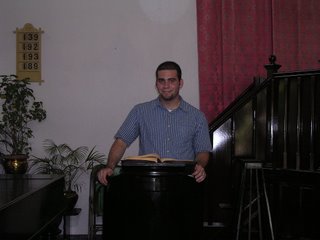
William Carey's Pulpit at Carey Baptist Church in Kolkata
History knows William Carey as the father of the modern missions movement. He was a man who was accomplished as a Pastor, Theologian and Linguist. During his lifetime, he founded the first modern church plant, wrote the first treatise on the work of missions, translated the bible into over 100 Indian dialects (most of which are still being used today) and taught Sanskrit at Calcutta University. God has caused the effects of his life to be felt up to our present day and, I'm sure, for many more generations to come! Yet, he was a man who toiled in the profession of a Cobbler for the first part of his life and even during his first years in India. God must have used that time to fuel his passion for ministry and zeal to be freed up to pursue ministry endeavors with all his time.
The story is told that one Sunday, some disgruntled members of his congregation at Lal Bazaar Baptist Chapel hung their sandals in his pulpit before he arrived for the morning worship service. In Indian society, this is one of the worst insults you can direct at someone. Carey, when he climbed into his pulpit to begin the service saw the sandals and tooke them from the pulpit. As he looked at the sandals, he began to tell the congregation how he was only a simple Cobbler who desired to please the Lord with his life and the ministry entrusted to him.
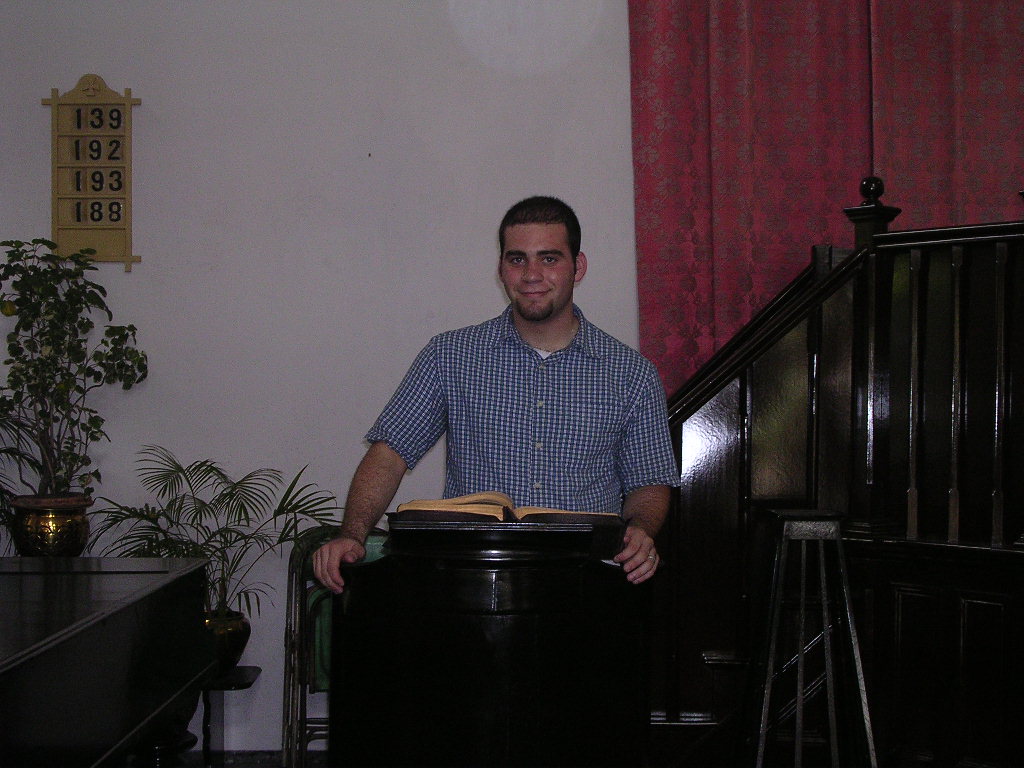
William Carey's Pulpit at Carey Baptist Church in Kolkata
Subscribe to:
Posts (Atom)


